
For decades, the standard response to a sprain or strain has been the straightforward RICE protocol—Rest, Ice, Compression, and Elevation. This approach became a cornerstone of school health offices, athletic training, and home care. Contemporary evidence, however, demonstrates that while select elements retain short-term utility, optimal recovery from soft-tissue injuries requires a more nuanced, progressive strategy that balances protection with early, controlled movement.
Sprains (ligament injuries) and strains (muscle or tendon injuries) rank among the most frequent incidents in K-12 settings, often occurring during physical education, recess, or sports. Both trigger an inflammatory response that produces pain, swelling, and temporary loss of function. In the immediate acute phase—typically the first one to three days—protecting the tissue remains essential to limit further damage. Many clinicians therefore retain targeted components of RICE, such as brief compression and elevation to manage edema and discomfort, while de-emphasizing complete rest and routine icing.
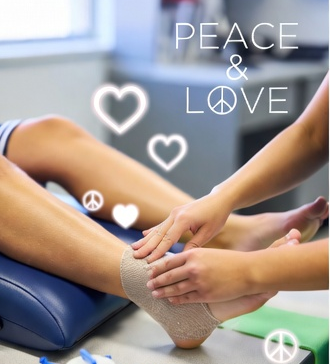
The evolution in best practice is captured by the PEACE & LOVE framework, introduced in the British Journal of Sports Medicine and now widely endorsed across sports medicine and rehabilitation literature. PEACE guides initial care: Protection (unload the area for 1–3 days), Elevation, Avoid anti-inflammatories (to preserve natural healing signals), Compression, and Education (empowering students and families with realistic expectations). This transitions into LOVE: Load (gradual, pain-guided activity), Optimism, Vascularization (promoting blood flow), and Exercise (targeted strength and mobility work). This staged approach recognizes that tissues heal best under controlled mechanical stress, which aligns collagen fibers, restores circulation, and rebuilds neuromuscular control—substantially reducing re-injury risk.
School health assistants play a pivotal role in translating these principles into practice. For mild to moderate injuries, the priority is brief protection followed by symptom-guided return to movement. Supportive taping, bracing, or compression wraps can stabilize the joint while function returns. Severe cases—marked by inability to bear weight, deformity, or intense pain—warrant immediate referral for medical evaluation to rule out fracture or significant tear. Routine use of anti-inflammatory medications is now approached with caution, as they may blunt the very inflammatory processes essential for tissue repair.
In essence, modern care does not discard RICE entirely; it contextualizes it within a broader continuum. Early swelling control gives way to progressive loading, strengthening, and functional rehabilitation. When school personnel apply this evidence-based progression, students experience faster recovery, fewer missed days, and lower recurrence rates.
The takeaway for school health teams is clear: protect first, then promote movement. By moving beyond outdated rest-only advice to the PEACE & LOVE model, we equip students with the most effective path to safe, complete healing.